Here is the Weekly Schedule of Readings and Assignments for the
Information Ethics class starting on January 9th.
Each week, there will be relevant InfoEthicist postings as well
as ongoing comments. I will make a list indicating which older
postings go with each week. Co-ordinating these two web environments
will be a challenge and part of our learning for the term. Your
suggestions are welcome.
Weekly Schedule of Readings and Assignments
Assignments 1: Introduce yourselves and get busy with the readings and assignments.
January 9, 2009
Week 1: Information Ethics: Defining Information Ethics for Today
Introduction to information ethics in relation to other areas of applied ethics, including computer ethics, cyberethics, bioethics, engineering ethics, media ethics, and related areas in research and public policy; Hot topics for today.
Readings for Blog 1 (Week 2):
The InfoEthicist http://infoethicist.blogspot.com (See key to the blog.)
International Center for Information Ethics http://icie.zkm.de
Elrod and Smith, Information ethics, in ESTE—The Encyclopedia of Science, Technology, and Ethics (Hagerty Library E-Reference) http://www.library.drexel.edu
Froehlich, “A brief history of information ethics.” Look in ICIE
Tavani, Ethics and technology, Chapters 1 and 2
In Cyberethics Reader, Chapter 1-- Bynum, Johnson, Moor, Adam, Floridi & Sanders, and Gert
Assignments 2: Blog Posting 1: Defining Information Ethics for Today
January 16, 2006
Week 2: Information Ethics in History and Philosophy—The Past as Prologue; Philosophy of information and philosophy of technology as applied in contemporary life—family, work, entertainment, sports, national and global security
Readings for Blog 2 (Week 3):
L. Winner, “Do artifacts have politics?” See The InfoEthicist http://infoethicist.blogspot.com
R. Capurro, “Information technologies and technologies of the self.”
J. Margolis, “The technological self.” This may not be available until later in the quarter.
Tavani, Ethics and technology, Chapter 3
Look for related articles in ESTE, http://www.library.drexel.edu
For Blog 5 (Week 7):
In Cyberethics Reader, Skim articles in Chapters 2 and 3 on Regulating the Net and Intellectual Property in Cyberspace
Assignments 3: Blog Posting 2: Artifacts and Politics; Technologies of the Self and Beginning of the Wikipedia Project
January 23, 2006
Week 3: Decision-Making 1
Various models of decision making in professional practice and civic participation
Readings for Blog 3 (Week 4):
In Cyberethics Reader J. Moor, “Just consequentialism and computing.”
Potter Box Resources (See The InfoEthicist http://infoethicist.blogspot.com )
For Blog 5 (Week 7):
In Cyberethics Reader, Skim articles in Chapter 4 on Privacy
Tavani, Chapter 5 on Privacy
Review Tavani, Chapters 1-3
Assignments 4: Blog Posting 3: Just Consequentialism and the Potter Box in Information Ethics and the Wikipedia Project
January 30, 2006
Week 4: Decision-Making 2
Readings for Blog 4 (Week 6)
Tavani, Chapter 4 and Appendices A, B, and C
Cyberethics Reader, Chapter 6 on Professional Ethics, Codes of Conduct, and Computer/Information Professionals
ALA http://www.ala.org ACM http://www.acm.org CPSR http://www.cpsr.org ASIST http://www.asis.org and many others See LII http://www.lii.org
See The InfoEthicist http://infoethicist.blogspot.com on professional issues
Assignments 5: Electronic Portfolio Progress Report (Draft of E-Pathfinder)
February 6, 2006
Week 5: Professional Practice, Ethics, and Law
Readings for Blog 5 (Week 7):
Cyberethics Reader, Skim Chapter 5 on Security and Crime in Cyberspace
Tavani, Chapter 7: Cybercrime
Tavani, Chapters 10-11: Social Issues
Use the resources on The InfoEthicist http://infoethicist.blogspot.com
Assignments 6: Blog Posting 4: Professional Codes: Traditions and the Future and Final Copy for the Wikipedia Project
February 13, 2006
Week 6: Public Policy, Professional Ethics, and Law
The application of information ethics to professional practice and participation in public policy, including the relationship between ethics and law.
Readings for Blog 5 (Week 7)
Review Cyberethics Reader, Chapter 6
Use The InfoEthicist http://infoethicist.blogspot.com
Assignments 7: Blog Posting 5: Information Professionals and Public Policy
February 20, 2006
Week 7: Current Ethical Dilemmas--- Access and Ownership
Readings:
Tavani, Chapter 8 and 9
Electronic Frontier Foundation
http://www.eff.org
Assignments 8: Website Operational
February 27, 2006
Week 8: Current Ethical Dilemmas--- Privacy and Security
Readings:
Review Privacy Readings
The Electronic Privacy Information Center
http://www.epic.org
Assignments 9: Optional posting of electronic pathfinder
March 6, 2006
Week 9: Current Ethical Dilemmas--- Community
Readings:
Review Tavani, Chapters 10 and 11
UNESCO http://www.unesco.org
Assignments 10: Electronic Portfolio Due
March 13, 2006
Week 10: The Future of Information Ethics
Saturday, January 07, 2006


Thursday, January 05, 2006
Global Information Ethics and Policy
I've been asked to help some people who are working on a book in LIS
in Chinese and English. Here is a tentative outline. Someone else will
be doing the Chinese translation. Good think for me, not to mention
the readers. MMS
in Chinese and English. Here is a tentative outline. Someone else will
be doing the Chinese translation. Good think for me, not to mention
the readers. MMS
Global Information Ethics and Policy:
Challenges for Cyberspace Citizens
Chapter Outline for LIS Book
Martha M. Smith
Drexel University
Introduction: Global Information Challenges in Ethics and Policy
I. Historical and Philosophical Background
A. Ethics and Information Technology at the End of the 20th Century: The Bomb, Big Science, Big Medicine, and Big Business
B. Major Philosophical Traditions for Decision-Making: Duties, Consequences, and Virtue
C. The Global Context: Digital Divides and Universal Values
1. The Digital Divides: Money, Education, Communication, and Mobility
2. The Universal Declaration of Human Rights: 1948 and 1998
3. Regulation of the Internet
4. Ubiquitous Computing
II. From Ethics to Policy: Access, Ownership, Privacy, Security, and Community
This section will present an overview of major ethical issues under the five categories noted above. The specific issues will be described in terms of the ethical principles and the conflicting interests of the various stake holders involved. The analysis will set the stage for the next section on the public policy aspects of each issue.
A. Access vs. Ownership
1. Intellectual Property: Copyright and Copyleft
2. The Right to Know and the Right to Information
3. Barriers to Information Access: Misinformation, Information Hiding, and Language Obstacles
4. The Open Source Movement and the Roles of Library and Information Professionals
5. The Public’s Right to Information vs. Personal and Corporate Privacy
B. Privacy vs. Security
1. Personal Privacy in Business and Healthcare
2. Secure Systems and the Hacker Ethos
3. Safety in Cyberspace
C. Community: Learning, Working, and the Joys of Life
1. Learning: Lifelong Pursuit
2. Working: The Private and Public Sectors
3. Family Life, Leisure, and the Arts
III. From Policy to Ethics: Custom, Law, and Building Global Consensus
This section will describe current public policy debates and how local as well as national and international practices and problems shaping law and custom. Complex interaction xxx and the winners and losers and the prospects from the future.
A. Current Winners: Literacy, Wealth, and Property
B. Current Losers: War, Disease, and Poverty
C. More Winners than Losers and the Problem of Unintended Consequences
IV. Global Information Justice and the Future
This section will present an approach to global information justice that considers the competing claims of humanity and nature with the potential of technologies. The goal of global information justice will be peace and its gifts to humanity and nature.
A. Humanity: Personal Identity and Social Responsibility
B. Nature: Preserving the Planet
C. Technology: Building the Instruments of Peace
Notes and Bibliography
Tables
Challenges for Cyberspace Citizens
Chapter Outline for LIS Book
Martha M. Smith
Drexel University
Introduction: Global Information Challenges in Ethics and Policy
I. Historical and Philosophical Background
A. Ethics and Information Technology at the End of the 20th Century: The Bomb, Big Science, Big Medicine, and Big Business
B. Major Philosophical Traditions for Decision-Making: Duties, Consequences, and Virtue
C. The Global Context: Digital Divides and Universal Values
1. The Digital Divides: Money, Education, Communication, and Mobility
2. The Universal Declaration of Human Rights: 1948 and 1998
3. Regulation of the Internet
4. Ubiquitous Computing
II. From Ethics to Policy: Access, Ownership, Privacy, Security, and Community
This section will present an overview of major ethical issues under the five categories noted above. The specific issues will be described in terms of the ethical principles and the conflicting interests of the various stake holders involved. The analysis will set the stage for the next section on the public policy aspects of each issue.
A. Access vs. Ownership
1. Intellectual Property: Copyright and Copyleft
2. The Right to Know and the Right to Information
3. Barriers to Information Access: Misinformation, Information Hiding, and Language Obstacles
4. The Open Source Movement and the Roles of Library and Information Professionals
5. The Public’s Right to Information vs. Personal and Corporate Privacy
B. Privacy vs. Security
1. Personal Privacy in Business and Healthcare
2. Secure Systems and the Hacker Ethos
3. Safety in Cyberspace
C. Community: Learning, Working, and the Joys of Life
1. Learning: Lifelong Pursuit
2. Working: The Private and Public Sectors
3. Family Life, Leisure, and the Arts
III. From Policy to Ethics: Custom, Law, and Building Global Consensus
This section will describe current public policy debates and how local as well as national and international practices and problems shaping law and custom. Complex interaction xxx and the winners and losers and the prospects from the future.
A. Current Winners: Literacy, Wealth, and Property
B. Current Losers: War, Disease, and Poverty
C. More Winners than Losers and the Problem of Unintended Consequences
IV. Global Information Justice and the Future
This section will present an approach to global information justice that considers the competing claims of humanity and nature with the potential of technologies. The goal of global information justice will be peace and its gifts to humanity and nature.
A. Humanity: Personal Identity and Social Responsibility
B. Nature: Preserving the Planet
C. Technology: Building the Instruments of Peace
Notes and Bibliography
Tables
Monday, January 02, 2006
Info679: Publications on the ICIE
Take a look at this clever way of presenting scholarly publications to the Information Ethics community.
http://icie.zkm.de/publications/virtualLibraries
See Floridi, Ess, and others.
http://icie.zkm.de/publications/virtualLibraries
See Floridi, Ess, and others.
Friday, December 30, 2005
Info679: Assignments: Electronic Pathfinders
Assignments: Electronic Pathfinders For the major assignment in this class, you may choose to prepare an electronic pathfinder on a topic in information ethics and related issues.
For some examples, look here:
From the Internet Public Library http://www.ipl.org/div/pf/entry/48488
Also, the Librarians' Index to the Internet http://www.lii.org
Look here also:
http://home.wsd.wednet.edu/pathfinders/path.htm
For more ideas, look in some of the usual places--
Search the article databases such as LibraryLit, LISA, and ERIC--
http://www.library.drexel.edu
Check out some major academic library sites and invisible web sites such as the Library of Congress. http://www.loc.gov
Try some unusual search engines: Kartoo http://www.kartoo.com Clusty http://www.clusty.com For more see http://www.searchenginewatch.com
Possible Topics Include (See more on the Bb site):
For some examples, look here:
From the Internet Public Library http://www.ipl.org/div/pf/entry/48488
Also, the Librarians' Index to the Internet http://www.lii.org
Look here also:
http://home.wsd.wednet.edu/pathfinders/path.htm
For more ideas, look in some of the usual places--
Search the article databases such as LibraryLit, LISA, and ERIC--
http://www.library.drexel.edu
Check out some major academic library sites and invisible web sites such as the Library of Congress. http://www.loc.gov
Try some unusual search engines: Kartoo http://www.kartoo.com Clusty http://www.clusty.com For more see http://www.searchenginewatch.com
Possible Topics Include (See more on the Bb site):
- The Global Digital Divide
- Healthcare Ethics and Information Technology
- Ethical Practices in Internet Research
- Philosophy of Information
- Philosophy of Technology
- Using Information in Homeland Security
- Datamining in Public Health
- Privacy and Health Records
- Social Responsibility and the Information Industry
- Intellectual Property Rights vs. the Public's Right to Information
- Children's Rights to Information
- The Ethics of Internet Regulation
- Librarians and the USA Patriot Act
- Copyright and CopyLeft
- The Ethics of the Open Source Movement
- Diversity in Librarianship
- Monitoring in the Workplace: Ethical Perspectives on Personnel Policies
- The Ethics of Service to Underserved Population
- Preserving World Cultures
- The UN Universal Declaration of Human Rights
- UNESCO and Information Ethics
- Issues in Information Ethics in Fiction
- Issues in Information Ethics in Film
Thursday, December 29, 2005
Info679: The Syllabus
Information Ethics at Dragon U: Take a look at the syllabus outline. I'll be making some changes before class officially begins on January 9th.
*******************************************************
Martha M. Smith, Ph. D.
marti.smith@cis.drexel.edu
215-895-1532
msmith@infoethics.org
http://www.cis.drexel.edu/faculty/msmith
Course Description:
Presents the philosophical foundations of applied ethics and technology with primary focus on (1.) the uses and abuses of information, (2.) human moral agency in relation to new information and communication technologies (ICTs), and (3.) the meaning of social responsibility in the global information society, including the concepts of global information justice and human rights.
Specifically this course will consider ethical dilemmas, decision-making strategies, and public policy issues around the broad themes of Access, Ownership, Privacy, Security, and Community including headline topics such as intellectual property rights vs. intellectual freedom; the USA Patriot Act vs. civil liberties; the uses of genetic information for health care vs. for discrimination in insurance. The course will build understanding of major and alternative ethical traditions to inform personal moral agency, professional conduct, and civic participation.
*******************************************************
College of Information Science and Technology
Drexel University
Winter, 2005-2006
INFO679 Online
Information Ethics
Drexel University
Winter, 2005-2006
INFO679 Online
Information Ethics
Martha M. Smith, Ph. D.
marti.smith@cis.drexel.edu
215-895-1532
msmith@infoethics.org
http://www.cis.drexel.edu/faculty/msmith
Course Description:
Presents the philosophical foundations of applied ethics and technology with primary focus on (1.) the uses and abuses of information, (2.) human moral agency in relation to new information and communication technologies (ICTs), and (3.) the meaning of social responsibility in the global information society, including the concepts of global information justice and human rights.
Specifically this course will consider ethical dilemmas, decision-making strategies, and public policy issues around the broad themes of Access, Ownership, Privacy, Security, and Community including headline topics such as intellectual property rights vs. intellectual freedom; the USA Patriot Act vs. civil liberties; the uses of genetic information for health care vs. for discrimination in insurance. The course will build understanding of major and alternative ethical traditions to inform personal moral agency, professional conduct, and civic participation.
Overview of Topics:
Week 1: Introduction to information ethics in relation to other areas of applied ethics, including computer ethics, cyberethics, bioethics, engineering ethics, media ethics, and related areas in research and public policy;
Week 2: Philosophy of information and philosophy of technology as applied in contemporary life—family, work, entertainment, sports, national and global security;
Weeks 3 and 4: Various models of decision making in professional practice and civic participation;
Weeks 5 and 6: The application of information ethics to professional practice and participation in public policy, including the relationship between ethics and law;
Weeks 7 to 10: Current ethical dilemmas under the broad categories of:
Ø Access,
Ø Ownership,
Ø Privacy,
Ø Security, and
Ø Community such as intellectual property rights, copyright, and copyleft; the USA Patriot Act and civil rights; the digital divide and information democracy; and global information justice.
Assignments and Grading:
Electronic Portfolio: The major assignment for this course will be the building of an electronic portfolio focused on current topics such as (1.) the protection of personal information, (2) information ethics in healthcare, (3.) the global digital divide, (4.) national security and civil liberties, (5.) intellectual property rights vs. the right to know, (6.) DNA information and cloning, (7.) nanotechnology, (8.) the information industry; and containing assignments such as weekly journal entries, resource pathfinders, and an information ethics case study problem for analysis.
Blog Postings: Five blog postings (Weeks 2, 3, 4, 6, and 7) will be due on Mondays by noon of each week. Weekly postings should be between 200-300 words and should reflect the readings with engagement with the assignment question or topic. You may use charts, tables, and hotlinks in your text and may attach small audio and video files. You will post your reflections to your own blog forum on the course site and interact with others in your small, blog ring group.
Grades will be based upon the following:
(50%) Major Term Project: The Completed Electronic Portfolio on a Current Issue (Progress report due in Week 5—15%; Final due in Week 10—35%)
(40%) 5 Blog Postings and Interaction with Other Students in a Blog Ring (Weeks 2, 3, 4, 6, and 7 )
(10%) Collaboration and Cooperative Learning (Class Participation, Initiative, Creativity, and more)
Grading Scale
A= 90-100
B= 80-89
C= Below 79
Special Needs and Accommodations: If you have a disability and need special help, you must identify yourself to the Drexel Disability Office in time for your needs to be reviewed and appropriate plans made for help.
Required Texts:
Herman Tavani. (2004) Ethics and technology: Ethical issues in an age of information and communication technology. John Wiley. See http://www.wiley.com/college/tavani
Richard A. Spinello and Harman T. Tavani (eds.) (2003), Readings in cyberethics. 2nd ed. Jones and Bartlett. Also see web resources at http://www.jbpub.com/cyberethics/toolsforlearning.cfm
Fiction, Movies, and Media
Selected short stories, novels, movies, radio, and audio resources. For examples, please refer to the Master Syllabus for Global Information Ethics. We will be adding more selections throughout the term. Your suggestions are welcome.
Web Resources
Examples of Optional Readings and Resources: The reading books below may be valuable in your professional library. Other readings and resource lists will be given throughout the term.
Richard Holeton (ed.) (1997). Composing cyberspace: Identity, community, and knowledge in the electronic age. WCB/McGraw Hill. Also see companion website at http://www.mhhe.com/socscience/english/holeton
Richard A. Spinello and Harman T. Tavani (eds.) (2001), Readings in cyberethics. Jones and Bartlett. Also see web resources at http://www.jbpub.com/cyberethics/toolsforlearning.cfm
Albert Teich (ed.), Technology and the Future. Wadsworth. Most recent edition. Also see companion website, Albert Teich’s Technology and the Future Toolkit, at http://www.alteich.com/
Weekly Schedule of Readings and Assignments:
Week 1: Information Ethics in the News
Introduction to information ethics in relation to other areas of applied ethics, including computer ethics, cyberethics, bioethics, engineering ethics, media ethics, and related areas in research and public policy;
Week 2: Information Ethics in History and Philosophy—The Past as Prologue
Philosophy of information and philosophy of technology as applied in contemporary life—family, work, entertainment, sports, national and global security;
Weeks 3: Decision-Making 1
Various models of decision making in professional practice and civic participation;
Week 4: Decision-Making 2
Week 5: Professional Practice, Ethics, and Law
Week 6: Public Policy, Professional Ethics, and Law
The application of information ethics to professional practice and participation in public policy, including the relationship between ethics and law;
Week 7: Current Ethical Dilemmas--- Access and Ownership
Week 8: Current Ethical Dilemmas--- Privacy and Security
Week 9: Current Ethical Dilemmas--- Community
Week 10: The Future of Information Ethics
Ø Community such as intellectual property rights, copyright, and copyleft; the USA Patriot Act and civil rights; the digital divide and information democracy; and global information justice.
Sunday, December 25, 2005
Info679: Information Ethics from the ESTE
Big News-- The Hagerty Library just added the electronic version of the Encyclopedia of Science, Technology, and Ethics to its collection. Check out the cool interface (Gale Reference Collection) and pay special attention to the article on Information Ethics by Ed Elrod and Martha Smith (your humble professor). For those of you outside of the Drexel network, take a look at the Gale site for more info on this terrific resources (out the summer of 2005). Other articles and authors of interest including Luciano Floridi.
Go to the Hagerty Library site to find this resource: http://www.library.drexel.edu
Also, take a look at the indexing with hyperlinks. Very cool.
Go to the Hagerty Library site to find this resource: http://www.library.drexel.edu
Also, take a look at the indexing with hyperlinks. Very cool.
Saturday, December 24, 2005
Info679: Essential Readings: The Biggies
Key Readings: If you read nothing else, read these:
Weeks 1-3 (This list is complete.)
Elrod and Smith. 2005. Information ethics. In The Encyclopeida of Science, Technology, and Ethics. See Hagerty Library's electronic reference.
Smith, M. 1992 Infoethics for leaders, in Library Trends, Winter, 1992. See if the text is online or look for it in your local library or order from ILL. (Your searching skills are very important in this class.)
Capurro, R. Information technologies and technologies of the self. http://icie.zkm.de This is the website for the International Center for Information Ethics
Moor, J. Just consequentialism and computing, in Spinello and Tavani (2nd ed.) Text for the course.
Floridi, L. and Sanders, J. W. The foundationalist debate in computer ethics, in Spinello and Tavani (2nd ed.) Text.
Weeks 4-6 (More for these weeks will be posted later.)
Winner, Do artifacts have politics? See text on Infoethicist blog. Note the date when this was written.
Smith, Global information justice. Library Trends. (See how many indexes lead you to the full text of the article. Also, see if which libraries in your local area have Library Trends or other periodicals in the field of library and information science.)
Weeks 6-10 (More will be added here.)
Lessig, L. The laws of cyberspace, in Spinello and Tavani (2nd ed.) Text.
Also see Lessig's presence on the web. Try Clusty http://www.clusty.com ; also Kartoo http://www.kartoo.com ; try Google Scholar http://scholar.google.com Look for Lessig in the literature of library and information science.
Anytime
The Universal Declaration of Human Rights http://www.unesco.org
ALA: Code of Ethics and Intellectual Freedom Statement http://www.ala.org
ACM: Code of Ethics http://www.acm.org Also in Spinello and Tavani (2nd ed.)
Weeks 1-3 (This list is complete.)
Elrod and Smith. 2005. Information ethics. In The Encyclopeida of Science, Technology, and Ethics. See Hagerty Library's electronic reference.
Smith, M. 1992 Infoethics for leaders, in Library Trends, Winter, 1992. See if the text is online or look for it in your local library or order from ILL. (Your searching skills are very important in this class.)
Capurro, R. Information technologies and technologies of the self. http://icie.zkm.de This is the website for the International Center for Information Ethics
Moor, J. Just consequentialism and computing, in Spinello and Tavani (2nd ed.) Text for the course.
Floridi, L. and Sanders, J. W. The foundationalist debate in computer ethics, in Spinello and Tavani (2nd ed.) Text.
Weeks 4-6 (More for these weeks will be posted later.)
Winner, Do artifacts have politics? See text on Infoethicist blog. Note the date when this was written.
Smith, Global information justice. Library Trends. (See how many indexes lead you to the full text of the article. Also, see if which libraries in your local area have Library Trends or other periodicals in the field of library and information science.)
Weeks 6-10 (More will be added here.)
Lessig, L. The laws of cyberspace, in Spinello and Tavani (2nd ed.) Text.
Also see Lessig's presence on the web. Try Clusty http://www.clusty.com ; also Kartoo http://www.kartoo.com ; try Google Scholar http://scholar.google.com Look for Lessig in the literature of library and information science.
Anytime
The Universal Declaration of Human Rights http://www.unesco.org
ALA: Code of Ethics and Intellectual Freedom Statement http://www.ala.org
ACM: Code of Ethics http://www.acm.org Also in Spinello and Tavani (2nd ed.)
Tuesday, December 20, 2005
Info679: The Traditions of Librarianship
The Tradition of Librarianship
as They Inform Information Ethics
Access
Intellectual Freedom
Freedom to Read
Privacy and Confidentiality
Service
Balanced Collections
Professional Neutrality
Respect for All (including employees)
Access
Intellectual Freedom
Freedom to Read
Privacy and Confidentiality
Service
Balanced Collections
Professional Neutrality
Respect for All (including employees)
On the traditions of librarianship, see the website of the American Library Association (http://www.ala.org ) and other resources on the history of librarianship, particularly in the United States.
Access
Intellectual Freedom
Freedom to Read
Privacy and Confidentiality
Service
Balanced Collections
Professional Neutrality
Respect for All (including employees)
Keep these in mind as we move through the term together.
Monday, December 19, 2005
Info679: Shall We Wiki?
Blogs and now wiki's. Take a look at the Wiki world.
This is the key wiki we'll talk about this term. Shall we contribute an article about Information Ethics for Wikipedia? Set up an account and see how it works.
http://www.wikipedia.org
Also take a look at http://www.liswiki.com/wiki/Main_Page
We'll not only talk about using wiki tools and contributing to them, but also consider starting wiki groups ourselves and the big topic of social networking in cyberspace.
This is the key wiki we'll talk about this term. Shall we contribute an article about Information Ethics for Wikipedia? Set up an account and see how it works.
http://www.wikipedia.org
Also take a look at http://www.liswiki.com/wiki/Main_Page
We'll not only talk about using wiki tools and contributing to them, but also consider starting wiki groups ourselves and the big topic of social networking in cyberspace.
Info679: Free Access to Information from Libraries Unlimited
Free Access to Information from Libraries Unlimited
One of the most useful ways that publishers can promote themselves is to invite free access to their sources. In this case, Libraries Unlimited has given open access to the Online Dictionary of Library and Information Science. As publishers struggles to know what business models will work in the new information environment, initiatives like this are to be applauded. We'll look for other examples of this kind of service from other publishers. Think about this: If you were working for a publisher in library and information science or in another academic field, how would you envision the future both for business and for social responsibility. See below:
http://www.lu.com/odlis
One of the most useful ways that publishers can promote themselves is to invite free access to their sources. In this case, Libraries Unlimited has given open access to the Online Dictionary of Library and Information Science. As publishers struggles to know what business models will work in the new information environment, initiatives like this are to be applauded. We'll look for other examples of this kind of service from other publishers. Think about this: If you were working for a publisher in library and information science or in another academic field, how would you envision the future both for business and for social responsibility. See below:
http://www.lu.com/odlis
Sunday, December 11, 2005
Info679: "Do Artifacts Have Politics?" By Langdon Winner
See the full text of Langdon Winner's famous article, "Do Artifacts Have Politics?" 1986
http://www-personal.si.umich.edu/~rfrost/courses/Women+Tech/readings/Winner.html
Think about how you would update this article's key question for the information and communications of today--- the Internet? Internet filtering? IM-ing? Pod casting? Mobile phones? Computer in the classroom? Blogging? Wiki's? Virtual reference? Napster et al.?
What else?
http://www-personal.si.umich.edu/~rfrost/courses/Women+Tech/readings/Winner.html
Think about how you would update this article's key question for the information and communications of today--- the Internet? Internet filtering? IM-ing? Pod casting? Mobile phones? Computer in the classroom? Blogging? Wiki's? Virtual reference? Napster et al.?
What else?
Info679: The Universal Declaration of Human Rights
The Universal Declaration of Human Rights
Look especially at Article 19.
Info679: Information Ethics at UNESCO
Information Ethics at UNESCO http://www.unesco.org
Check out the links below:
Portals - Real time updates
Archives Portal
Links:7836
Categories:1137
Updated:
2005-12-09
Libraries Portal
Links:14209
Categories:899
Updated:
2005-12-04
Information Society Observatory
Links:2054
Categories:303
Updated:
2005-12-05
Free & Open Source Software Portal
Links:697
Categories:78
Updated:
2005-10-
Info679: Information Ethics on the Invisible Web
Sources for Information Ethics on the Invisible or Deep Web? Where to Look!
Take a look at this useful pathfinder on the Invisible Web!
http://www.lib.berkeley.edu/TeachingLib/Guides/Internet/InvisibleWeb.html
Take a look at this useful pathfinder on the Invisible Web!
http://www.lib.berkeley.edu/TeachingLib/Guides/Internet/InvisibleWeb.html
Info679: WebJunction: Preparing the Current and the Next Generation
WebJunction: Preparing the Current and the Next Generation
http://www.webjunction.org
WebJunction is a substantial partnership to promote libraries and librarianship. Funded largely by the Bill and Melinda Gates Foundation and co-ordinated by OCLC and others, WebJunction is an experiment in providing educational resources in a virtual community setting. See for yourself what WebJunction can do to help you enhance your work and service.
http://www.webjunction.org
WebJunction is a substantial partnership to promote libraries and librarianship. Funded largely by the Bill and Melinda Gates Foundation and co-ordinated by OCLC and others, WebJunction is an experiment in providing educational resources in a virtual community setting. See for yourself what WebJunction can do to help you enhance your work and service.
Info679: Pathfinders from the Internet Public Library
Pathfinders from the Internet Public Library
These will give you an idea of the format and scope. Look for other examples and articles about pathfinders and bibliographic instruction.
Marti's Faculty Website
Take a look http://www.cis.drexel.edu/faculty/msmith
I had wonderful help in setting this up. Feel free to get help from your friends and colleagues who know about building websites. MMS
I had wonderful help in setting this up. Feel free to get help from your friends and colleagues who know about building websites. MMS
Saturday, December 10, 2005
From Outsell --Neighborhoods of the Information Industry
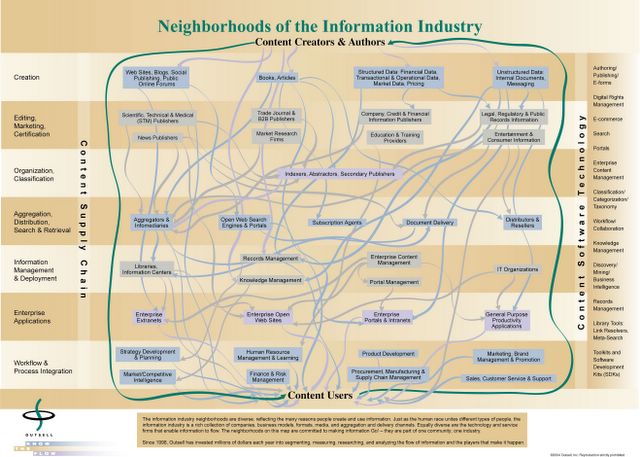
From Outsell-- Neighborhoods of the Information Industry-- For educational use only.

Get your own poster copy of this chart from Outsell. Use a new search engine to look for Outsell's website. If you do not have one in mind, look at http://searchenginewatch.com
Friday, December 09, 2005
Blog This: Why are we using a blog for an online course?
Blog This: Why are we using a blog for an online course, for Information Ethics? Blogging is an important new way of communicating for library and information science professionals and in libraries.
Are we still going to use our Blackboard course site? Yes, indeed.
We're going to be innovative and brave in this course, using blogging, the course site, and lots of other new ways to learn and communicate. For me, part of studying ethics in a graduate, professional course is experiencing moral and ethical challenges. In actual practice, we find ourselves confronting new technologies and needing to decide whether or not to add them to our professional and/or personal lives. If we think of new technologies as potential technologies of the self, then all new technologies require our moral imagination to accept or reject them. Let's get concrete and think what difference it makes to use any kind of personal technology-- silverware for eating, cars for transportation, TV's and movies for entertainment. Now translate that into the professional context of the information professions and ask how we understand our use of online systems and databases, printers and fax machines, and now blogs and podcasting? How do these technologies change us, our work, and self-understanding. Think about all of this as you are using various technologies of the self to do the work in this course.
Are we still going to use our Blackboard course site? Yes, indeed.
We're going to be innovative and brave in this course, using blogging, the course site, and lots of other new ways to learn and communicate. For me, part of studying ethics in a graduate, professional course is experiencing moral and ethical challenges. In actual practice, we find ourselves confronting new technologies and needing to decide whether or not to add them to our professional and/or personal lives. If we think of new technologies as potential technologies of the self, then all new technologies require our moral imagination to accept or reject them. Let's get concrete and think what difference it makes to use any kind of personal technology-- silverware for eating, cars for transportation, TV's and movies for entertainment. Now translate that into the professional context of the information professions and ask how we understand our use of online systems and databases, printers and fax machines, and now blogs and podcasting? How do these technologies change us, our work, and self-understanding. Think about all of this as you are using various technologies of the self to do the work in this course.
Monday, December 05, 2005
Info679: Assignments--The Online Portfolio-- Life on the Web
Assignments--The Portfolio-- Life on the Web
You'll present your work and learning for Information Ethics on a website of your own creation. The site can be very simple or very complicated. The point is to experience presenting yourself on the web. Do you already have a web site? That's great. You can set up a spot for our class. If not, then you'll be able to consider several alternatives.
You may want to start with the Drexel resources:
Web/Media
IRT
NEWS!!
SERVICES
Computer Accounts
The Computer Fixer
Web/Media Support
WebITS Getting Started Web Workshops Online Courses FAQs Contact Us
Publishing Your Website on University Servers
Once you have all of your web documents (HTML files, graphics, etc.), you will need to place the files on a web server. Once the web pages and the graphical files are placed on the web server, your web site will be available to the world. There are a variety of web servers at Drexel and MCP Hahnemann:
The web server associated with DUNX1 (http://dunx1.irt.drexel.edu) also known as http://www.pages.drexel.edu
Drexel's main web server (http://www.drexel.edu)
WebCT server (http://webct.drexel.edu)
Determing which server to useUse the descriptions below to decide which server best suits your needs.
Personal home pages - FOR EVERYONE
Personal web pages for students, faculty and staff are stored on the DUNX1 server and can be mounted using a DUNX1 userid and password.
Anyone with a dunx1.irt.drexel.edu account has the ability to create her own web page.
Your dunx1.irt.drexel.edu account's userid and password are that same as your mail.drexel.edu account.
Recognized student organizations - can store their home pages on DUNX1. The organization will need an organizational dunx1 account. The organization must be recognized by the university and registered with the Office of Student Life.
Administrative Departments
Drexel departmental web sites can be stored on Drexel's main web server called www.drexel.edu. Representatives of academic or administrative departments may request access to place information on Drexel's main web server. If interested you may request access by contacting us via the form located on the Contact Us page of this site.
Courses - FOR FACULTY
Faculty may use WebCT to complement their courses. Click here for more information. or email webct@drexel.edu
You'll present your work and learning for Information Ethics on a website of your own creation. The site can be very simple or very complicated. The point is to experience presenting yourself on the web. Do you already have a web site? That's great. You can set up a spot for our class. If not, then you'll be able to consider several alternatives.
You may want to start with the Drexel resources:
Web/Media
IRT
NEWS!!
SERVICES
Computer Accounts
The Computer Fixer
Web/Media Support
WebITS Getting Started Web Workshops Online Courses FAQs Contact Us
Publishing Your Website on University Servers
Once you have all of your web documents (HTML files, graphics, etc.), you will need to place the files on a web server. Once the web pages and the graphical files are placed on the web server, your web site will be available to the world. There are a variety of web servers at Drexel and MCP Hahnemann:
The web server associated with DUNX1 (http://dunx1.irt.drexel.edu) also known as http://www.pages.drexel.edu
Drexel's main web server (http://www.drexel.edu)
WebCT server (http://webct.drexel.edu)
Determing which server to useUse the descriptions below to decide which server best suits your needs.
Personal home pages - FOR EVERYONE
Personal web pages for students, faculty and staff are stored on the DUNX1 server and can be mounted using a DUNX1 userid and password.
Anyone with a dunx1.irt.drexel.edu account has the ability to create her own web page.
Your dunx1.irt.drexel.edu account's userid and password are that same as your mail.drexel.edu account.
Recognized student organizations - can store their home pages on DUNX1. The organization will need an organizational dunx1 account. The organization must be recognized by the university and registered with the Office of Student Life.
Administrative Departments
Drexel departmental web sites can be stored on Drexel's main web server called www.drexel.edu. Representatives of academic or administrative departments may request access to place information on Drexel's main web server. If interested you may request access by contacting us via the form located on the Contact Us page of this site.
Courses - FOR FACULTY
Faculty may use WebCT to complement their courses. Click here for more information. or email webct@drexel.edu
Info679: Readings-- Using the Hagerty Databases for Books and Articles
Using the Hagerty Databases for Books and Articles
http://www.library.drexel.edu To access Drexel library's subscription journals, you will need your Student ID #. XXXXXXXX
Below I've posted some of the links, but be sure to navigate the site itself as well.
Articles databases: Start with the ACM Digital Library, LibraryLiterature, LISA, and ERIC
W. W. Hagerty Library
Health Sciences Libraries
Archives
Drexel University Libraries
Hours
Resources
Library Services
About the Libraries
All Electronic ResourcesLibrary CatalogCourse ReservesDatabases by SubjectDatabases by TitleE-journalsE-books E-theses E-newspapers E-reference New ResourcesSubject GuidesTutorials/Online Instruction Other Area Libraries
Borrowing Library MaterialsInterlibrary Loans E-Z BorrowCheck your Library RecordReference AssistanceLibrary InstructionOff-campus Access
Services for: New Students Faculty Distance Learners Patrons with Disabilities
Libraries and CollectionsHoursLocationsStaff/Phone NumbersLibrary Newsletter Visitor Information Computing FacilitiesPolicies Make a SuggestionContact Us
eBook databases:
OCLC WorldCat:
Digital Reference:
Print Books: InterLibrary Loan
http://www.library.drexel.edu To access Drexel library's subscription journals, you will need your Student ID #. XXXXXXXX
Below I've posted some of the links, but be sure to navigate the site itself as well.
Articles databases: Start with the ACM Digital Library, LibraryLiterature, LISA, and ERIC
W. W. Hagerty Library
Health Sciences Libraries
Archives
Drexel University Libraries
Hours
Resources
Library Services
About the Libraries
All Electronic ResourcesLibrary CatalogCourse ReservesDatabases by SubjectDatabases by TitleE-journalsE-books E-theses E-newspapers E-reference New ResourcesSubject GuidesTutorials/Online Instruction Other Area Libraries
Borrowing Library MaterialsInterlibrary Loans E-Z BorrowCheck your Library RecordReference AssistanceLibrary InstructionOff-campus Access
Services for: New Students Faculty Distance Learners Patrons with Disabilities
Libraries and CollectionsHoursLocationsStaff/Phone NumbersLibrary Newsletter Visitor Information Computing FacilitiesPolicies Make a SuggestionContact Us
eBook databases:
OCLC WorldCat:
Digital Reference:
Print Books: InterLibrary Loan
Info679: Readings--Luciana Floridi--- Information Ethics: On the Philosophical Foundation of Computer Ethics
Historical Perspectives on the Beginnings of Information Ethics
How to read this article? Skim and pay attention to the basic arguement and the footnotes rather than the complex analysis. Of special interest to those who are interesting in the history of scholarly communication and the development of the field of information ethics.
Intro to the reading: This reading is important to our course because it represents the term, information ethics, being used by a very well respected scholar in the philosophy of information and in computer ethics. This article represents a turning point in the growth of the field of information ethics because it brings the terminology into the arena of scholarly discourse in the most established field of computer ethics. After this article there is a marked increased in the use of the term information ethics being used the in scholarly literature of computer ethics.
Note that Floridi makes a case for information ethics as foundational to computer ethics based on his definition of information and the philosophy of information. Floridi represents the analytic style of philosophy and seeks to define basic categories that can serve as building blocks for developing ethical theory. The descriptive style of ethics doesn't depend upon specific definitions in order to address practical ethical challenges. Both the descriptive and the analytical styles are valuable. Analytical reflection provides a basic framework for moving toward rules or norms for conduct and policy making. The descriptive style is not as oriented around rules and norms. We talk about that more later.
http://www.wolfson.ox.ac.uk/~floridi/ie.htm
Information Ethics: On the Philosophical Foundation of Computer Ethics
Luciano Floridi, version 2.0
A shorter version of this paper was given at ETHICOMP98 The Fourth International Conference on Ethical Issues of Information Technology, Erasmus University, The Netherlands, 25 to 27 March 1998, hosted by the Department of Philosophy Erasmus University, The Netherlands, in association with Centre for Computing and Social Responsibility De Montfort University, UK, Research Center on Computing and Society Southern Connecticut State University, USA, East Tennessee State University, USA.
The paper is forthcoming in the Proceedings of the conference and I shall gratefully acknowledge any useful comments or suggestions for improvements. Please send your emails to Luciano.Floridi@philosophy.ox.ac.uk
For a list of resources see A Short Webliography on Computer Ethics
For information on research in CE in recent years in the fields of philosophy and computing, see the Appendix
For a reading list see A Short Reading List on the Philosophy of Computer Ethics
Index of the paper sections
The Foundationalist Problem
Macroethics and Computer Ethics
A Model of Macroethics
From Computer Ethics to Information Ethics
Information Ethics as an Object-oriented and Ontocentric Theory
The Properties of the Infosphere
The Normative Aspect of Information Ethics: Four Moral Laws
Information Ethics as a Macroethics
Case Analysis: Four Negative Examples
Conclusion
Information Ethics: On the Philosophical Foundation of Computer Ethics
"We, who have a private life and hold it infinitely the dearest of our possessions…"
Virginia Woolf, "Montaigne"
in A Woman’s Essays (London: Penguin, 1992), p. 60.
1. The Foundationalist Problem
Lobbying, financial support and the undeniable importance of the very urgent issues discussed by Computer Ethics (henceforth CE) have not yet succeeded in raising it to the status of a philosophically respectable topic. If they take any notice of it (see appendix), most philosophers look down on CE as on a practical subject ("professional ethics"), unworthy of their analyses and speculations. They treat it like Carpentry Ethics, to use a Platonic metaphor.
The inescapable interdisciplinarity of CE has certainly done the greatest possible harm to the prospects for recognition of its philosophical significance. Everyone’s concern is usually nobody’s business, and CE is at too much of a crossroads of technical matters, moral and legal issues, social as well as political problems and philosophical analyses to be anyone’s own game. Philosophers’ notorious conservatism may also have been a hindrance. After all, Aristotle, Mill or Kant never
How to read this article? Skim and pay attention to the basic arguement and the footnotes rather than the complex analysis. Of special interest to those who are interesting in the history of scholarly communication and the development of the field of information ethics.
Intro to the reading: This reading is important to our course because it represents the term, information ethics, being used by a very well respected scholar in the philosophy of information and in computer ethics. This article represents a turning point in the growth of the field of information ethics because it brings the terminology into the arena of scholarly discourse in the most established field of computer ethics. After this article there is a marked increased in the use of the term information ethics being used the in scholarly literature of computer ethics.
Note that Floridi makes a case for information ethics as foundational to computer ethics based on his definition of information and the philosophy of information. Floridi represents the analytic style of philosophy and seeks to define basic categories that can serve as building blocks for developing ethical theory. The descriptive style of ethics doesn't depend upon specific definitions in order to address practical ethical challenges. Both the descriptive and the analytical styles are valuable. Analytical reflection provides a basic framework for moving toward rules or norms for conduct and policy making. The descriptive style is not as oriented around rules and norms. We talk about that more later.
http://www.wolfson.ox.ac.uk/~floridi/ie.htm
Information Ethics: On the Philosophical Foundation of Computer Ethics
Luciano Floridi, version 2.0
A shorter version of this paper was given at ETHICOMP98 The Fourth International Conference on Ethical Issues of Information Technology, Erasmus University, The Netherlands, 25 to 27 March 1998, hosted by the Department of Philosophy Erasmus University, The Netherlands, in association with Centre for Computing and Social Responsibility De Montfort University, UK, Research Center on Computing and Society Southern Connecticut State University, USA, East Tennessee State University, USA.
The paper is forthcoming in the Proceedings of the conference and I shall gratefully acknowledge any useful comments or suggestions for improvements. Please send your emails to Luciano.Floridi@philosophy.ox.ac.uk
For a list of resources see A Short Webliography on Computer Ethics
For information on research in CE in recent years in the fields of philosophy and computing, see the Appendix
For a reading list see A Short Reading List on the Philosophy of Computer Ethics
Index of the paper sections
The Foundationalist Problem
Macroethics and Computer Ethics
A Model of Macroethics
From Computer Ethics to Information Ethics
Information Ethics as an Object-oriented and Ontocentric Theory
The Properties of the Infosphere
The Normative Aspect of Information Ethics: Four Moral Laws
Information Ethics as a Macroethics
Case Analysis: Four Negative Examples
Conclusion
Information Ethics: On the Philosophical Foundation of Computer Ethics
"We, who have a private life and hold it infinitely the dearest of our possessions…"
Virginia Woolf, "Montaigne"
in A Woman’s Essays (London: Penguin, 1992), p. 60.
1. The Foundationalist Problem
Lobbying, financial support and the undeniable importance of the very urgent issues discussed by Computer Ethics (henceforth CE) have not yet succeeded in raising it to the status of a philosophically respectable topic. If they take any notice of it (see appendix), most philosophers look down on CE as on a practical subject ("professional ethics"), unworthy of their analyses and speculations. They treat it like Carpentry Ethics, to use a Platonic metaphor.
The inescapable interdisciplinarity of CE has certainly done the greatest possible harm to the prospects for recognition of its philosophical significance. Everyone’s concern is usually nobody’s business, and CE is at too much of a crossroads of technical matters, moral and legal issues, social as well as political problems and philosophical analyses to be anyone’s own game. Philosophers’ notorious conservatism may also have been a hindrance. After all, Aristotle, Mill or Kant never
Info679: Rafael Capurro--Information Technologies and Technologies of the Self
(Note that this posting is part of a course on Information Ethics for Dragon U. I will be editing it in the next few weeks. The course starts officially in January.)
Introduction to the Reading: Compare this article with Floridi's paper on the foundations of information ethics. Capurro's paper is an excellent example of the descriptive style of ethical reflection. It is informed by the traditions of philosophy represented by Habermas, Foucault, Ricoeur, and Ihde. Capurro is the scholar who work I identify with most. When I first got into the field, this is the article that made me want to work in the field. Over the years Capurro has become a good friend as well as a colleague. Take time to look at his web page.
Info679: Reading: Rafael Capurro, Information Technologies and Technologies of the Self
http://www.capurro.de/self.htm
See Capurro's own webpage. Note that he has posted most of his published works.
http://www.capurro.de
Introduction to the Reading: Compare this article with Floridi's paper on the foundations of information ethics. Capurro's paper is an excellent example of the descriptive style of ethical reflection. It is informed by the traditions of philosophy represented by Habermas, Foucault, Ricoeur, and Ihde. Capurro is the scholar who work I identify with most. When I first got into the field, this is the article that made me want to work in the field. Over the years Capurro has become a good friend as well as a colleague. Take time to look at his web page.
Info679: Reading: Rafael Capurro, Information Technologies and Technologies of the Self
http://www.capurro.de/self.htm
See Capurro's own webpage. Note that he has posted most of his published works.
http://www.capurro.de
Info679: Key Web Sites
Info679: Key Web Sites
Required Texts:Herman Tavani. (2004) Ethics and technology: Ethical issues in an age of information and communication technology. John Wiley. See http://www.wiley.com/college/tavani
Richard A. Spinello and Harman T. Tavani (eds.) (2003), Readings in cyberethics. 2nd ed. Jones and Bartlett. Also see web resources at http://www.jbpub.com/cyberethics/toolsforlearning.cfm
International Center for Information Ethics http://icie.zkm.de
International Review of Information Ethics http://www.i-r-i-e.net
American Library Association http://www.ala.org See the Office of Intellectual Freedom
Electronic Privacy Information Center (EPIC) http://www.epic.org
American Civil Liberties Union-- ACLU http://www.aclu.org
More to come. As you find good sites, please add them to our list.
Required Texts:Herman Tavani. (2004) Ethics and technology: Ethical issues in an age of information and communication technology. John Wiley. See http://www.wiley.com/college/tavani
Richard A. Spinello and Harman T. Tavani (eds.) (2003), Readings in cyberethics. 2nd ed. Jones and Bartlett. Also see web resources at http://www.jbpub.com/cyberethics/toolsforlearning.cfm
International Center for Information Ethics http://icie.zkm.de
International Review of Information Ethics http://www.i-r-i-e.net
American Library Association http://www.ala.org See the Office of Intellectual Freedom
Electronic Privacy Information Center (EPIC) http://www.epic.org
American Civil Liberties Union-- ACLU http://www.aclu.org
More to come. As you find good sites, please add them to our list.
Info679: Library Blogs
Info679: Look for examples of library or library-related blogs from your area. Share what you find with your fellow students. We'll post some of the most relevant on our External Links area of Bb. Start with http://www.lii.org Be sure to look for library blogs in the libraries and other institutions near you. Does your library or information workplace have a blog?
Info679: Why Use Blogging in Graduate Professional Education?
Info679: Why Use Blogging in Graduate Professional Education?
Explore this topic by looking for articles on blogging and the library and information professions in Library Lit and LISA. http://www.library.drexel.edu
Is "Blog" or "Blogging" a controlled vocabulary term in either index?
Explore this topic by looking for articles on blogging and the library and information professions in Library Lit and LISA. http://www.library.drexel.edu
Is "Blog" or "Blogging" a controlled vocabulary term in either index?
Teaching BioInfoEthics: A Course I'd Like to Teach
Below is an outline of a course that I would love to teach. It's designed for undergrad, grad students, professional programs, or continuing education. With so many issues in bioethics and healthcare ethics (DNA research, cloning, digital patient records, body data for surveillance and national security, datamining in public health) clearly focused around issues of information use and abuse, BioInfoEthics seems like a natural next step in applied ethics.
****************************************************************
****************************************************************
Teaching Bioinfoethics: Preparing Students for Decision-Making in Research, Practice, and Public Policy
Bioinfoethics: A field of applied ethics concerned with biomedical, living systems in relation to the information systems that enable or restrict the transfer (creation, organization, dissemination, evaluation, and use) of data, information, and knowledge between those living systems and individuals or institutions in the global society.
Bioinfoethics: A field of applied ethics concerned with biomedical, living systems in relation to the information systems that enable or restrict the transfer (creation, organization, dissemination, evaluation, and use) of data, information, and knowledge between those living systems and individuals or institutions in the global society.
***************************
Scientific American recently called the field of bioinformatics the new gold rush because genetics without bioinformatics has no future. (Scientific American, 7/2000) If so, then in the coming years, bioinfoethics may not be far behind. The ethical questions are already in the news.
Scientific American recently called the field of bioinformatics the new gold rush because genetics without bioinformatics has no future. (Scientific American, 7/2000) If so, then in the coming years, bioinfoethics may not be far behind. The ethical questions are already in the news.
- Who should own the Human Genome or have access to data about it?
- Does the promise of new drug therapies justify exclusive proprietary access to genetic information?
- Should genetic testing be required for jobs or parenthood?
- Shall we as a society constrain cloning and cloning research or is cloning an appropriate reproductive technology?
- Do the claims of public safety trump concerns for personal privacy in mandating DNA databanks?
- Is iris identification or body scanning a necessary security technology--in sensitive workplaces, in public spaces?
- Should brain fingerprinting be used to prosecute the guilty and exonerate the innocent?
******************************************
Looking back almost fifty years from the perspective of 2000, after Dolly the sheep and the rapid conquest of the human genome, one could argue that Joseph Fletcher in 1954, signaled the beginnings of bioinfoethics with his book, Morals and medicine: The moral problems of: The patient's right to know the truth, contraception, artificial insemination, sterilization, euthanasia.
Fletcher asserted that the patient has the right to know the truth about a terminal illness or about reproductive choices. Despite its lack of constitutional status, the right to know has been more and more morally compelling in the last few decades. With the power to have relevant information and use that information in making decisions, the patient/consumer shares a responsibility that was once held exclusively by the physician. The right to know has entered into public policy with provisions for informed consent and advanced directives. Beyond medicine, the public's right to know is often affirmed. For example, the environmental movement, typified in the annual celebration of Earth Day, grew from public concern with threats to clear air, water, soil and access to research data, sometimes from whistle-blowers, to build a case for change in government and industry practices. The Internet has fostered the notion that everyone has the right to know everything all the time and even to have free music and other copyrighted materials. While 24/7 access to all of the world's knowledge is not very realistic, still the expectation of instant information gratification has never been higher.
Many of the issues in medical ethics and environmental ethics that were once controversial now seem almost tame compared to the clashes of values in genetics and bioinformatics. And the stakes are high as matters of profit, life, insurance, and death collide. The field of applied ethics (medical ethics, environmental ethics, information and computer ethics, mass media ethics, cyberethics, and business ethics) has a rich literature and a distinguished history of analysis and insight to use in engaging these new challenges.
Many of the issues in medical ethics and environmental ethics that were once controversial now seem almost tame compared to the clashes of values in genetics and bioinformatics. And the stakes are high as matters of profit, life, insurance, and death collide. The field of applied ethics (medical ethics, environmental ethics, information and computer ethics, mass media ethics, cyberethics, and business ethics) has a rich literature and a distinguished history of analysis and insight to use in engaging these new challenges.
*******************************
When biology and medicine meet informatics (information systems management, statistics, computer science) and they meet on the Internet, then new complexities require renewed reflection. The curriculum proposed will use the concepts of Identity, Knowledge, and Community to analyze current issues in light of philosophical and ethical traditions. The needs of undergraduate, professional, and graduate students, both technical and non-technical, will be addressed. A classroom-based, web-based, or combination of setting will be considered as well as the wealth of print, electronic, and multi-media resources available to enrich teaching and learning. Below is a sampling of books, papers, and web sites that would be useful in preparation. ************************************
Bynum, Terrell W. and Rogerson, Simon. (Eds.) (1996). Global information ethics: Selected Papers from ETHICOMP95. Science and Engineering Ethics (UK). 1996 2:129-256.
When biology and medicine meet informatics (information systems management, statistics, computer science) and they meet on the Internet, then new complexities require renewed reflection. The curriculum proposed will use the concepts of Identity, Knowledge, and Community to analyze current issues in light of philosophical and ethical traditions. The needs of undergraduate, professional, and graduate students, both technical and non-technical, will be addressed. A classroom-based, web-based, or combination of setting will be considered as well as the wealth of print, electronic, and multi-media resources available to enrich teaching and learning. Below is a sampling of books, papers, and web sites that would be useful in preparation. ************************************
Bynum, Terrell W. and Rogerson, Simon. (Eds.) (1996). Global information ethics: Selected Papers from ETHICOMP95. Science and Engineering Ethics (UK). 1996 2:129-256.
#####
Capurro, Rafael. 1996. Information technology and technologies of the self, Journal of Information Ethics 5(2):19-28.
#####
Capurro, Rafael. 1996. Information technology and technologies of the self, Journal of Information Ethics 5(2):19-28.
#####
Fletcher, Joseph. (1988). The ethics of genetic control: Ending reproductive roulette. Buffalo, NY: Prometheus Books.
#####
#####
Floridi, Lucas. (1999): Information ethics: On the philosophical foundation of computer ethics. http://www.wolfson.ox.ac.uk/~floridi/ie.htm.
#####
#####
Johnson, Deborah G. (1994). Computer ethics. (2nd ed.). Englewood Cliffs, NJ: Prentice-Hall.
#####
#####
Jonas, Hans. (1966). The phenomenon of life: Toward a philosophical biology. Chicago: University of Chicago Press.
#####
#####
Jonas, Hans. (1984). The imperative of responsibility: In search of an ethics for a technological age. Chicago: University of Chicago Press.
#####
#####
Mason, Richard, Mason, Florence, and Culnan, Mary. (1995). The ethics of information management. Thousand Oaks, CA: Sage.
#####
#####
Mitcham, Carl. (1995). Computers, information and ethics: A review of issues and literature. Science and Engineering Ethics, 1 (2):113-132.
#####
#####
Nash, R. F. (1989). The rights of nature: A history of environmental ethics. Madison: University of Wisconsin Press.
#####
#####
Smith, Martha M. (1997). Information ethics. Annual Review of Information Science and Technology (ARIST), Vol. 32, 1997 (pp. 339-366). Medford, NJ: Information Today for the American Society for Information Science (ASIS).
**************************************************************
**************************************************************
Finally, some possible directions for the research agenda of bioinfoethics will be suggested including consideration of global ethical traditions and the role of international non-governmental organizations (NGO's) such as UNESCO (United Nations Economic, Social, and Cultural Organization) and documents such as the Universal Declaration of Genetic Rights (http://www.unesco.org/ ).
###
###
Observatory on the Information Society
http://www.unesco.org/webworld/observatory/index.shtml - (1999-2000): World Communication and Information Report 1999-2000
http://www.unesco.org/webworld/wcir/en/
UNESCO. Observatory on the Information Society. URL:
UNESCO. Observatory on the Information Society. URL:
http://www.unesco.org/webworld/index.html
UNESCO. Webworld Infoethics. URL:
UNESCO. Webworld Infoethics. URL:
United Nations General Assembly. (1948). Universal Declaration of Human Rights.
###
Article 19. XIX. Article 19. The International Centre Against Censorship. URL: http://www.article19.org
###
Computer Professionals for Social Responsibility. URL: http://www.cpsr.org
###
Article 19. XIX. Article 19. The International Centre Against Censorship. URL: http://www.article19.org
###
Computer Professionals for Social Responsibility. URL: http://www.cpsr.org
Info679: Read this first: Introduction to the Course-- Defining Information Ethics
Introduction to the Course-- Defining Information Ethics and Locating Information Ethics among the Fields of Applied Ethics, Information, Computers, the Internet, Information and Communications Technologies and Lots of Other Stuff
For more on the history of information ethics and the contributions of many key scholars see:
The International Center for Information Ethics
http://icie.zkm.de
There are so many ways to define information ethics. Let me suggest a simple place to begin. Take a look at my blog posting here on February 23rd. This definition applies to the uses and abuses of information in the past, the present, and the future. While it's true that we are much more aware of information issues today, we can also use ethical analysis to understand the past. Of particular interest to us are inventions such as the alphabet, the book, the printing press, the telephone, the digital computer, the fax, and the Internet. What else comes to mind when you think of inventions that make information available or to hinder access to information? Next think of major events and periods of history that give us clues to the dynamics at work when humans come in contact with information and information technologies. Think of the beginnings of agriculture, the rise of cities, the Industrial Revolution, and the nuclear age. What information did the earliest farmers need? How did they learn how to grow crops? What about the rise of citities? Most historians note that record keeping was one of the characteristics of city life. Maybe there was an early Dilbert in the offices of early urban bureauracracies. Before the Industrial Revolution, we have the beginnings of printing. Do you see a relationship? Does being a reader, a literate person, change a person's self image? How? Who could learn to read in the early days? When did reading become an essential skill of living and learning? Think also about the rise of modern science and how the Industrial Revolution has shaped our world today. Think also of how education has changed over the centuries. Think of the history of higher education and the concept of the university. What was taught in the early American universities? When did the curriculum change? How is the curriculum changing today? If theology was the queen of the disciplines long ago and then was replaced by Science, will information technologies replace Science? Next we'll move on to some of the philosophical traditions to add to the historical bones we've been filling with flesh. Don't worry if you are not familiar with all of this history. We'll all be filling in our blanks throughout the course through our discussions among ourselves. We are always learning and never will know it all. That keeps us humble.
For more on the history of information ethics and the contributions of many key scholars see:
The International Center for Information Ethics
http://icie.zkm.de
Info679: Lecture 5-- Professional Practice, Ethics, and Law
Lecture 5-- Professional Practice, Ethics, and Law
There are many professional societies have codes or guidelines for ethical behavior of its members. While these codes inform member behavior, they are also important for presenting the values and goals of the group to the larger public. As you read the various codes, think of how they are understood by the insiders (professionals) and the public. One of the frequent criticisms of codes in the library and information science professions is that they lack any means of enforcement. Unlike the medical or legal professions, librarians, software designers, and information architects are not licensed or certified by the state. Think about what this means for the status and role of the profession and for the public image of the field. In what other ways do librarians and other information professionals seek to defend their value to society in the public arena and how do they engage as professionals in public policy advocacy?
See the various codes of interest:
American Library Association
http://www.ala.org See The Office of Intellectual Freedom
Computer Science
See also ACM http://www.acm.org
ASIST http://www.asis.org
Does SLA have a code of ethics? Why or why not? http://www.sla.org
Look at the groups of most interest to you to see if they have codes or other statements of ethical commitment.
ASIST
There are many professional societies have codes or guidelines for ethical behavior of its members. While these codes inform member behavior, they are also important for presenting the values and goals of the group to the larger public. As you read the various codes, think of how they are understood by the insiders (professionals) and the public. One of the frequent criticisms of codes in the library and information science professions is that they lack any means of enforcement. Unlike the medical or legal professions, librarians, software designers, and information architects are not licensed or certified by the state. Think about what this means for the status and role of the profession and for the public image of the field. In what other ways do librarians and other information professionals seek to defend their value to society in the public arena and how do they engage as professionals in public policy advocacy?
See the various codes of interest:
American Library Association
http://www.ala.org See The Office of Intellectual Freedom
Computer Science
See also ACM http://www.acm.org
ASIST http://www.asis.org
Does SLA have a code of ethics? Why or why not? http://www.sla.org
Look at the groups of most interest to you to see if they have codes or other statements of ethical commitment.
ASIST
Info679: Lecture 2--Information Ethics in History and Philosophy: The Past as Prologue
Lecture 2: Information Ethics in History and Philosophy-- The Past as Prologue
In this lecture I invite you to consider the historical and philosophical foundations of information ethics. In a previous lecture I covered some of the historical background. For much more, you may want to consult a good basic book such as The Control Revolution by James R. Beniger. For the philosophical background, you may want to consult the Encyclopedia of Philosophy noted below. Here I will present an outline of ideas and concepts for us to use throughout this term.
Moor seeks a unifying theory of ethics to apply to information, computing, and technology in current reflection and for decision and policy making. He calls his unifying theory "just consequentialism."
Moor--Consequentialism Constrained by Justice
Here Moor combines the two major traditions of ethical reflection-- utilitarianism and deontology.
Moor--The Good as the Enemy of the Just
Look for the conflict between the Good and the Just. How is this illustrate in controversies today? Take, for example, the tensions between those who produce music and those who download it.
Moor--Computing in Uncharted Waters
In this part of the discussion, Moor talkes about how ever new technologies present more and more challenges to our ethical analysis and our decision-making. See if you can find out who talks about ethics as "tentative ethics."
Also by James Moor-- What is Computer Ethics? 1985
Note this early article. The first mention of Information Ethics in articles came in 1988 ande 1989.
Also see Gert, Common Morality and Computing (in Spinello and Tavani)
Of importance here is an important distinction between morality and ethics.
We'll use morality to mean the ideas and practices that shape the everyday behavior
of ordinary people even when they are not reflecting on their actions. Ethics even
applied ethics, will be used to refer to intellectual reflection on morality, individual behavior,
practices and their justfications, and public policy. Note that Capurro and many others use this distinction.
In this lecture I invite you to consider the historical and philosophical foundations of information ethics. In a previous lecture I covered some of the historical background. For much more, you may want to consult a good basic book such as The Control Revolution by James R. Beniger. For the philosophical background, you may want to consult the Encyclopedia of Philosophy noted below. Here I will present an outline of ideas and concepts for us to use throughout this term.
From the Hagerty Library Site: http://www.library.drexel.edu
"Welcome to the Routledge Encyclopedia of Philosophy Online, or REP Online - your dynamic online resource for researching, teaching and studying in the philosophy arena and related disciplines.
·More than 2000 articles, from Aristotle to Nominalism and from Personal Identity to Zeno of Elea" Start with terms such as ethics, morals/morality, deontology, utilitarianism, analytic philosophy, I. Kant, norms/normative, duty, justice, John Rawls (theory of justice), applied ethics, social ethics, social responsibility.
Moor seeks a unifying theory of ethics to apply to information, computing, and technology in current reflection and for decision and policy making. He calls his unifying theory "just consequentialism."
Moor--Consequentialism Constrained by Justice
Here Moor combines the two major traditions of ethical reflection-- utilitarianism and deontology.
Moor--The Good as the Enemy of the Just
Look for the conflict between the Good and the Just. How is this illustrate in controversies today? Take, for example, the tensions between those who produce music and those who download it.
Moor--Computing in Uncharted Waters
In this part of the discussion, Moor talkes about how ever new technologies present more and more challenges to our ethical analysis and our decision-making. See if you can find out who talks about ethics as "tentative ethics."
Also by James Moor-- What is Computer Ethics? 1985
Note this early article. The first mention of Information Ethics in articles came in 1988 ande 1989.
Also see Gert, Common Morality and Computing (in Spinello and Tavani)
Of importance here is an important distinction between morality and ethics.
We'll use morality to mean the ideas and practices that shape the everyday behavior
of ordinary people even when they are not reflecting on their actions. Ethics even
applied ethics, will be used to refer to intellectual reflection on morality, individual behavior,
practices and their justfications, and public policy. Note that Capurro and many others use this distinction.
INFO679: Lecture 1-- Information Ethics in the News--Nature, Humanity, and Technology
INFO679: Information Ethics
Lecture 1: Information Ethics in the News
Welcome to Information Ethics. We'll start our course by exploring some of the hot information ethics issues in the news today and consider some of the thinking tools that we'll be using throughout the term.
Lecture 1: Information Ethics in the News
Welcome to Information Ethics. We'll start our course by exploring some of the hot information ethics issues in the news today and consider some of the thinking tools that we'll be using throughout the term.
- My approach to the field is very descriptive rather than normative. That means that first we will learn about what is happening in the real world and how different people, organizations, and governments are responding to the issues. Later on we'll consider the normative side of applied ethics. The normative side seeks to define the rules and practices that are the most morally justified. You may want to consults the basic online philosophy sources from the Hagerty Library (http://www.library.drexel.edu) when you need to understand the terminology. The plus, of course, is that you will be using online, digital reference sources.
******************************************************************************
One resources is the Routledge Encyclopedia of Philosophy Online. From the intro:
"Welcome to the Routledge Encyclopedia of Philosophy Online, or REP Online - your dynamic online resource for researching, teaching and studying in the philosophy arena and related disciplines.
·More than 2000 articles, from Aristotle to Nominalism and from Personal Identity to Zeno of Elea·Over 100 new articles added since launch of REP Online in 2000·October 2005"
*********************************************************************************
- Intellectual Property Rights vs. Intellectual Freedom
- Privacy: Personal and Public Implications
- Information Use for National Security
- The Global Digital Divide
- Regulating the Internet--Filtering and More
- The Uses of Information for Genetics
- The Open Source Movement
******See below a list of the concepts I'll be using throughout the term. I've noted where you will find the sources of these concepts and terms.*****
Terminology and Concepts
- Balancing Three Dimensions: Nature, Humanity, and Technology (See Capurro, Information Technology and Technologies of the Self
- Major Themes in Information Ethics: Access, Ownership, Privacy, Security, and Community (Smith, 1992)
- The Ethical Self (Smith, 1992)
- The Ethical Professional (Smith, 1992)
- The Global Information Environment (Smith, 1992)
- Global Information Justice (Smith, 200?)
**************************************************
The Tradition of Librarianship as They Inform Information Ethics
- Access
- Intellectual Freedom
- Freedom to Read
- Privacy and Confidentiality
- Service
- Balanced Collections
- Professional Neutrality
- Respect for All (including employees)
This introductory lecture is about some of the thinking tools that will benefit you in this course. There will be more detail as we move along.
Saturday, December 03, 2005
Current Writing Projects
Let me share a couple of projects that I'm working on right now. The major project is a special issue of the Journal of the American Society of Information Science and Technology on Global Information Ethics. I'm a co-editor with Dr. Toni Carbo from the University of Pittsburgh. We have a team of wonderful people working on papers. I'm writing a history and perspectives article to set the tone of the article; Toni is doing the formal intro to the issue. Right now I'm asking scholars in the field to send me short statements about what they remember about the beginnings of the field and how they got interested in research in the area.
Another project is a book of readings on Information Ethics and Policy. Again Toni Carbo and I are working together. We hope to gather up key readings that could be used in LIS courses or by general readings interested in the area. Our angle will be slightly different from what is available right now. We plan to include some official documents, early statements on the issues, and some hot policy issues in the news now. Suggestions? Let us know.
Another project is a book of readings on Information Ethics and Policy. Again Toni Carbo and I are working together. We hope to gather up key readings that could be used in LIS courses or by general readings interested in the area. Our angle will be slightly different from what is available right now. We plan to include some official documents, early statements on the issues, and some hot policy issues in the news now. Suggestions? Let us know.
Monday, October 17, 2005
INFO679: Information Ethics-- The Course
I'm back. It's been a busy fall, but now I'm ready to get back to regular blogging. I'll be teaching Information Ethics in our Winter Quarter at Dragon U. Hope some of my prospective students will find this blog a good way to get into the field. Also, I hope students will let me know what topics are of most interest. What are the hot topics that matter to you all? Privacy? National Security and the Patriot Act? Censorship? Internet Filtering? Evolution and Intelligent Design (the role of scientific information in society)? Information ethics and the media? Journalistic integrity and the privacy of sources? Privacy and health records, DNA, etc.? Start looking at TV, movies, newspapers, magazines, and Internet sites with some of these issues in mind....more to come.
Sunday, August 28, 2005
EP--Advising-- New Students' Fears--Can I Do This?
EP-- Advising--New Students's Fears--Can I Do This?
Can I Do This?
Over the years, our numbers suggest that most of our students in LIS programs are between 37 and 42. While averages don't show the range of ages, they do indicate that most of our students have been out of formal education for quite a long time. So some of you who fall into this category may be asking, "Can I succeed in grad school?" My answer is, "Yes you can and probably more successfully than you would ever imagine." Why is this? Let me suggest some of the advantages that older students have. Some advantages come from career clarity, life experience, and maturity. Those students who are currently in the workplace and especially those in libraries, publishers, or the information industry have even more reason to feel prepared. What about younger or less experienced students? Aren't those students more accustomed to school demands and more up on technology? I'd say "yes" and "no". Let me list the pluses that matter.
- Life experience matters because it gives us perspective and teaches patience.
- Life experience brings most people a fairly realistic view of themselves and their abilities.
- For many people, years of raising children, working, maintaining a house, managing money, and other adult life skills build a sense of confidence and also resilience in times of stress. I've told some students that changing thousands of diapers makes one able to face something as otherwise threatening statistics or html.
- To someone with a three year old or a demanding, but boring job, sitting and reading may seem like a vacation.
- If you want to do it, you can.
- Think of pursuing your degree as a new adventure and an investment in yourself far beyond what it may mean to your career.
- When it's hard and frustrating, be proud of yourself for facing the challenge.
- When it's fun, exciting, or you do really well, celebrate!
Saturday, August 27, 2005
EP--Advising--Why You Need Your Own Webpage
EP--Advising--Why You Need Your Own Webpage--- The Quick Answer
You will be so very pleased when you can have your own webpage for your job search or other professional opportunities.
Why start it now? Because you need time to learn about the content and to master the software and skills to make a good one.
Use the free services and support from Dragon U. to get started.
You will be so very pleased when you can have your own webpage for your job search or other professional opportunities.
Why start it now? Because you need time to learn about the content and to master the software and skills to make a good one.
Use the free services and support from Dragon U. to get started.
The Ethical P (EP)-- Advising-- Professional Degrees
The Ethical P (EP)-- Advising-- Professional Degrees
So what is a professional degree in a grad school? Why is a professional degree called a terminal degree? These are important questions for several reasons. The most significant one is the matter of grades. In a grad school's masters program like history or English, a masters degree normally leads to the Ph. D. or at least the notion that you may want to get into the a doctoral program. Not usually so with a professional degree. Think medicine, law, and library science. These are degrees that lead into certain professional fields without assuming additional formal education, although more education is not discouraged and there are internships, clerkships, and other such. The point is that terminal degrees are simply that--higher degrees are not dependent upon the profesional degree. So there is truly no need to obsess over grades. Most people get a mix of A's and B's. When we admit students, we expect them to do well. Most people do very well or else they drop out. It is truly your choice, so get the most out of the experience and focus on what you want to learn to meet your goals. As a library director, I was often suspicious of someone who only had A's. Why? Because the profession is about initiative and creativity as much as about completing assignments. I looked for people who would take on a challenge or something unknown and be willing to make mistakes. Just give it some thought.
The Ethical Professor-- Advising--New Section of the InfoEthicist
Welcome to the Ethical Professor-- Advising--New Section of the InfoEthicist
Ethical Professor--Advising
Ethical Professor--Advising--Disclaimers and Disclosures
As a part of the InfoEthicist, I'm going to explore the ethical dimensions of being a faculty member. I will invite my current students, advisees, and others to read and comment on the various topics I will be presenting. If you think of a topic you would like to present here, please consider a guest posting. Or start your own blog and I'll put in a link here. So shall we begin?
Advising--Disclaimers and Disclosures
I am currently on the faculty of a university. Let's call it Dragon U--DU for short. I'm not so concerned with any of you knowing where I am, but I would prefer that my blog not be easily visible on the web. We'll see how that works. In any case, whatever I write here is my own. I don't represent DU, only myself. I will not be discussing any official policies or other matters that require official decision-making. I'm not in charge of making those kinds of decisions anyway, so we should be ok. What I do want to do is to raise issues and provide whatever helpful suggestions I have on higher education, graduate education, professional education in Information, more specifically in Library and Information Science. My ideas have been shaped by my own personal history. I've only been working at DragonU for three years, just starting year four. I've been in higher educaton in one way or another for over thirty years. I've been a student in higher education for almost my whole life. I'm from the generation of women who went to college expecting to find husbands and a good life as a wife and mother. It worked for some, but for me I did get my first husband, a baby, and then a divorce and a real job to support myself and my baby. What a surprise. Even with two more husbands, I've continued to work one, two, or three jobs. I've gotten and needed more degrees. I've needed to move away from home and family to create my life. On another angle, I've taught and been an administrator in higher ed working with adult students since the early 1980's. Much of what you will read here comes from my experience and also from what I learned from Malcolm Knowles' writings and others who were early in articulating the difference in the ways we should educate adult learners in contrast to children and traditional age (18-21/22) people in higher ed. I love working with adults. So enough for this first post, more about me will come through in future posts. You can also learn more about me on the faculty website at DragonU. More details later.
Let me know that you are out there. Comments encouraged.
Tuesday, August 23, 2005
Blogging for ASIST-- Charlotte, 2005
New Blogging Adventure-- Joining the Bloggers to Support the ASIST Annual Meeting--2005--Charlotte, NC-- http://www.asis.org Having my own blog is so handy at a time like this---an invitation to do more blogging. But this year is very special. There are so many people in ASIST now working on my favorites--information ethics and ethics and technology issues. I'll see a lot of these people and many good friends in Charlotte. We'll be able to talk about our
new group blog GlobalInformationEthics (You can get there from here.) and all of our other projects. I'm so pleased that blogging is getting to be a popular way for people to interact at meetings. It's such a good way to get to know new people both before and after the meetings--such a good way for those who can not attend to see what happened and feel part of the action--such a different kind of record of how we work together. I see blogging and wiki networks as the greatest things for scholarly communication since the Internet. Who knows where this will lead.....but I want to be there.
new group blog GlobalInformationEthics (You can get there from here.) and all of our other projects. I'm so pleased that blogging is getting to be a popular way for people to interact at meetings. It's such a good way to get to know new people both before and after the meetings--such a good way for those who can not attend to see what happened and feel part of the action--such a different kind of record of how we work together. I see blogging and wiki networks as the greatest things for scholarly communication since the Internet. Who knows where this will lead.....but I want to be there.
Monday, June 06, 2005
From SLA: So You Want to Read Some Science Fiction related to Information Ethics?
Today I want to engage us in thinking about science fiction as it enlarges our vision and imagination for thinking about ethical issues for problem solving and decision-making. I'm currently attending the SLA meeting in Toronto http://www.sla.org . Tonight there is a session on science fiction related to technology and libraries of the future. I've used science fiction as well as other fiction in my infoethics classes. I'll report here what I learn tonight. Feel free to post your favorites. I'll start a short list here.
Science Fiction (Short Stories, Novels, and Poetry):
Let me start with Octavia Butler's work and short stories by Isaac Asimov and some of Ray Bradbury including Fahrenheit 451. Right now I'm looking for good examples on nanotechnology.
Science Fiction (Short Stories, Novels, and Poetry):
Let me start with Octavia Butler's work and short stories by Isaac Asimov and some of Ray Bradbury including Fahrenheit 451. Right now I'm looking for good examples on nanotechnology.
Sunday, May 08, 2005
The Information Ethics Archives--University of Pittsburgh
Information Ethics Archives
This summer Toni Carbo and I will start working on the newly established Information Ethics Archive at the University of Pittsburgh. Please consider sending us your papers and other materials in the future. We are looking for funding and will be able to count on the expertise of the archival staff in the library at Pitt. What a wonderful opportunity to document our field from its beginnings. You will hear more about this soon. Do contact me or Toni if you would like to contribute your papers, your money, and/or your expertise.
Sunday, May 01, 2005
Global Information Ethics--Announcing the Group Blog
http://globalinfoethics.blogspot.com Take a look and consider contributing. Email me if you are interested. Marti Smith msmith@infoethics.org
The new group blog is up for your reading and/or participation. Become a part-time blogger and see how we can co-operate in the creating a record of our ongoing scholarship and reflections. I have high hopes for this group blog. Let me share:
The new group blog is up for your reading and/or participation. Become a part-time blogger and see how we can co-operate in the creating a record of our ongoing scholarship and reflections. I have high hopes for this group blog. Let me share:
- Getting our message out to a wider audience
- Encouraging interaction among scholars and practitioners in the interdisciplinary studies of ethics and technology, very broadly defined-- STS (science, technology, and society), computer ethics, cyberethics, Internet ethics, healthcare ethics and technology, bioinfoethics, Internet research ethics, information policy, social responsibility, philosophy of technology, philosophy of information, and new fields we haven't imagined yet
- Creating an environment for big ideas, new ideas, wild ideas, humor, and fun
- Taking advantage of the blog phenonemon in all its fadishness and long-term potential
- Sharing our diversity of interests, topics, backgrounds, and languages-- Contributions in languages other than English are welcome.
- Tracking the development of our ideas, influences, and theoretical perspectives
- Creating an indexable record of our social networking and how social networking influences the growth of scholarship
- Making the links and other resources available more widely on the web and for tagging of content
- Experimenting with blogging, sharing the blogspace, and collaborative, co-operative learning.
- Facilitating blogging by busy people
- Providing a place for students to plug-in real time and encourage them to use blogging as a means of self-expression, self-publishing, resume-building, and professional development
- Encouraging international co-operation for conferences, co-publishing, and friendship
In a very hectic world, let's see what we can do together.
Saturday, April 30, 2005
Back to Blogging-- Doing What You Love!
So good to get back to the blog. Work and home this last month or so have both been very busy and filled with many distractions. I hear from so many friends that they feel like they are always rushing and putting off the things they love to do. My New Year's resolution this year was to have more fun, and I must admit that I have done pretty well. Now at least once a month I do something special. My fun has included the Philly Flower Show, a trip to the Philly Museum for an evening of jazz and wine with my daughter--to celebrate my birthday, and for May a trip to the Philly Museum for the Dali exhibit. In June, it will be a cruise to Bermuda. I've never done anything like that, but it's time. What I notice, even when I'm having fun and for sure while at work and certainly doing housework, is that I'm always thinking about information ethics and what would be good on the blog. I just love the blogging and miss it when I'm away. It does help to know that there are so many people involved in infoethics topics and lots of activity with new journals, many more conferences, and so much good scholarship being done. And these days it looks like soon I'll be teaching the infoethics class and doing some speaking so now I'm getting really focused. So I hope to be back here more often and also getting together with some others to launch the group blog-- GlobalInfoEthics. See you again here soon.
Thursday, March 24, 2005
Living Wills-- Very Powerful Information
I had a friend (don't we all) who needed a will, a living will, and a medical power of attorney as preparation for a difficult divorce in an abusive marriage. No gory details, but let's just say that she needed to protect her assets and herself just in case tempers got out of control. While not the same circumstances as the current news story about Terry Schiavo-- a battle between a husband and parents over the life of a fairly young woman-- this friend's story highlights how important certain documents--information--can be. Both stories also point to that green information--money and its power to shape reality. We'll have to address money and end of life issues another time starting with the basic will. Reminds me that I need to update all these documents.
Monday, March 21, 2005
The Searching Self-Part 1
What is the Searching Self
Some years ago I wrote a brief article on the searhing self. I'd been in a course in Cognitive Psychology working from the writings of Ulrich Neisser. What a rich body of literature. More on that later. In any case, I'm surprised that no one has picked up on the idea of how our identities are being shaped by all of the searching activities now part of everyday life. The practices of searching fit nicely into ideas about The Technological Self as articulated by many philosphers. (See Rafael Capurro--Information Technologies and Technologies of the Self; see http://icie.zkm.de and Rafael's own site).
Let's begin-- Think about how automobiles and related technologies (the highway system, fast food industry, and shopping malls) as technological artifacts have shaped our society. Now think about how our time and space are shaped by the computers we use. Think of how searching has shifted our engagement with computers, laptops, mobile phones, pdas. etc.
What does all this mean? More to come.....
Tuesday, March 15, 2005
Another Invitation to Join the Group Blog--GlobalInfoEthics
Another posting of my invitation for you to join the TeamInfoEthics Blog Group-- Email me at msmith@infoethics.org and let me know if you would like to participate.
Our group blog is set-up. Take a look at http://globalinfoethics.blogspot.com/Take a look, and let me know if you would like to be a part of the group. How about once a week or once a month? Let's see how it works.
Our group blog is set-up. Take a look at http://globalinfoethics.blogspot.com/Take a look, and let me know if you would like to be a part of the group. How about once a week or once a month? Let's see how it works.
Subscribe to:
Posts (Atom)